This week gave enterprise AI teams a useful reality check.
Google launched Gemini Enterprise Agent Platform. OpenAI introduced workspace agents in ChatGPT. AWS added new Bedrock AgentCore capabilities to get agents running faster.
Those are different products, but they point in the same direction.
Enterprise AI is moving beyond single prompts and isolated copilots. The new problem is how you run shared, long-lived agents inside a business without creating a governance mess.
That is the real story worth paying attention to.
What changed
All three launches are really about the same operational gap.
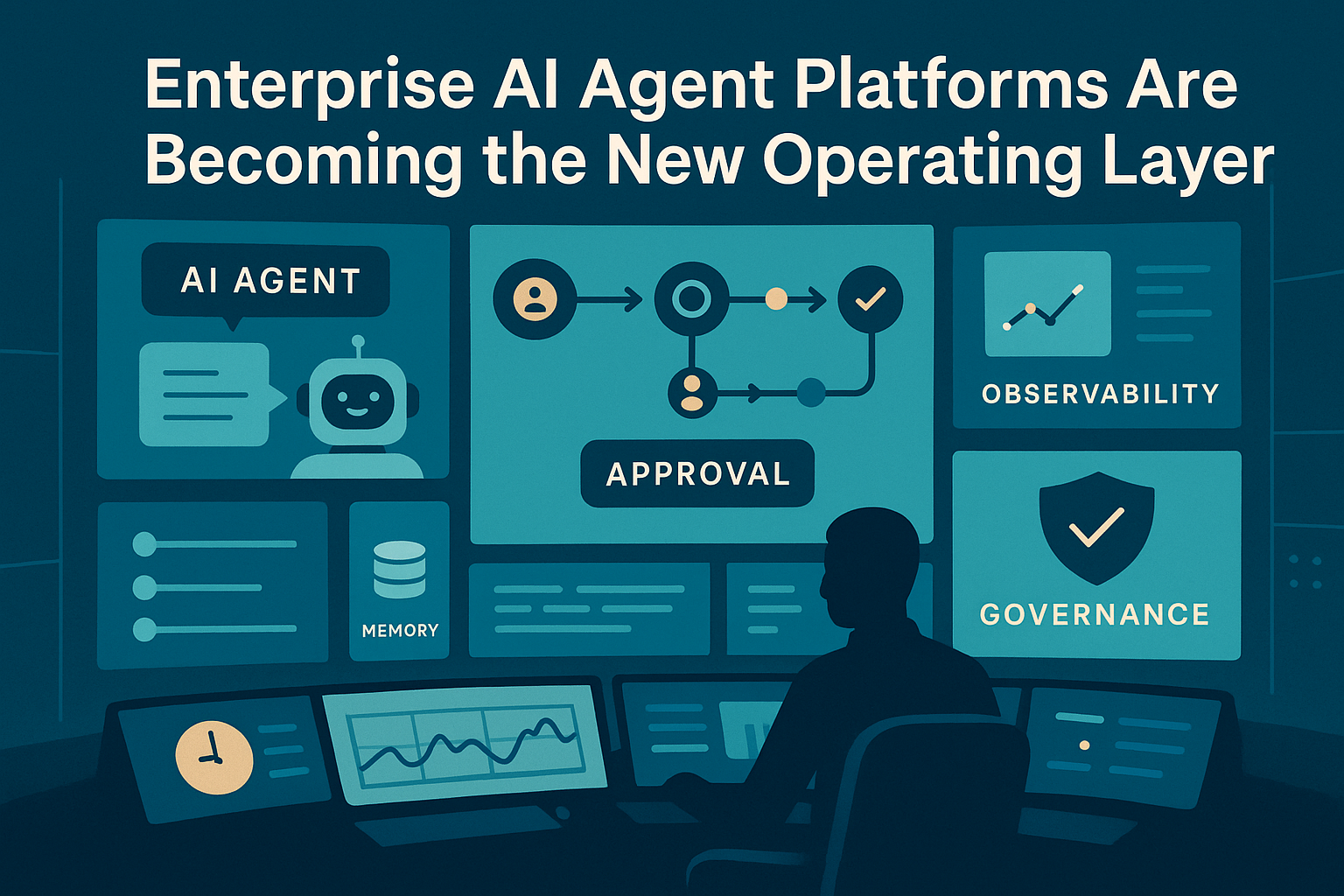
Google is packaging agent building, runtime, identity, memory, observability, and governance into one platform layer. OpenAI is pushing shared agents that can run in the cloud, connect to business tools, work across Slack and ChatGPT, and ask for approval on sensitive actions. AWS is reducing the infrastructure work needed to get an agent running, while keeping a path from simple managed harnesses to more custom orchestration.
If you strip away vendor language, the pattern is clear.
The market is shifting from model access to agent operations.
A year ago, the conversation was mostly about which model was smartest. Now the hard questions look different:
- Where does the agent run?
- What can it access?
- What identity does it use?
- What memory should persist?
- Which actions require approval?
- How do you trace what happened?
- Who owns the workflow once it starts acting on behalf of a team?
Those are not model questions. They are operating model questions.
Why it matters
A lot of enterprise AI work still behaves like the pilot era.
A team builds a useful assistant. It gets connected to a few internal systems. It starts saving time. Then somebody asks for shared access, background runs, Slack integration, auditability, or a way to stop it doing the wrong thing at 2 a.m.
That is when the architecture gets serious.
Long-running agents create a different class of risk from chat assistants.
They can trigger actions across systems, carry state across sessions, and quietly accumulate process authority. If you do not have a proper control layer around that, you end up with something awkward in the middle: too autonomous to manage casually, too fragile to trust at scale.
That is why these launches matter commercially.
They are a signal that enterprise buyers are no longer just shopping for model quality. They are shopping for a governed way to delegate work.
What most teams are missing
The common mistake is to think agent strategy is mainly a framework choice.
It usually is not.
Whether you use LangGraph, ADK, a managed vendor studio, or something homegrown matters, but it is rarely the hardest decision. The harder decision is what the platform contract should be between the business and the agent.
That contract needs to answer five things clearly.
1. Identity
An agent should not just be “some automation”. It needs a clear identity for permissions, audit, and cost ownership.
2. Runtime
If the agent is expected to run for minutes, hours, or across handoffs, you need a runtime that can survive retries, failures, approvals, and resumptions.
3. Memory
Persistent context is useful, but unmanaged memory becomes a liability fast. Teams need rules for what gets remembered, for how long, and under whose authority.
4. Observability
You cannot govern an agent you cannot inspect. Traces, tool calls, approval checkpoints, and failure patterns need to be visible to operators, not buried in debug logs.
5. Human control
The practical enterprise question is not whether agents should be autonomous. It is where autonomy stops.
That means defining approval boundaries for actions like sending external messages, editing records, filing tickets, touching financial data, or making customer-facing decisions.
The better way to think about it
Treat agent platforms as a new operating layer, not just another AI feature.
That sounds bigger than it is. It does not mean every company needs a huge internal platform team tomorrow. It means leaders should stop evaluating agents only at the workflow demo level.
The right question is this:
If this agent became genuinely useful, what would we need in place to trust it across a team, a business unit, or a regulated process?
That mindset changes what you prioritise.
Instead of obsessing over one perfect demo, you start designing for:
- shared ownership
- approval patterns
- environment isolation
- audit trails
- model substitution
- policy enforcement
- cost visibility
- rollback and kill switches
That is much closer to enterprise reality.
A practical checklist for AI leaders and architects
If your organisation is moving from copilots toward agents, these are the checks I would make now.
Decide where agent identity lives
Do not let every agent inherit a vague shared service account. Make ownership and permissions explicit.
Separate useful memory from dangerous memory
Not every workflow needs long-term memory. Add it where it improves outcomes, not because the platform makes it easy.
Define approval classes before rollout
Create simple categories such as observe, recommend, draft, execute-with-approval, and execute-within-policy. That gives teams a clearer deployment path.
Make observability a day-one requirement
If an agent can call tools or trigger downstream work, tracing should not be optional. This is especially important once agents start chaining multiple steps.
Avoid platform lock-in at the workflow level
Even if you use a managed platform, keep the business logic, evaluation criteria, and approval rules understandable outside the vendor UI. You want portability of judgment, even if you do not have full portability of runtime.
Pick one or two real workflows, not ten toy ones
The best test cases are recurring workflows with clear owners, measurable value, and manageable risk. Weekly reporting, internal triage, vendor review prep, and structured operational analysis are better starting points than vague “general assistant” experiments.
Bottom line
The interesting thing this week is not that Google, OpenAI, and AWS all launched more agent features.
It is that they are converging on the same lesson.
Enterprise agents are not just smarter chatbots. They are becoming a new operating layer for delegated work, and that layer needs runtime, identity, memory, observability, and human control built in.
The teams that understand this early will make better buying decisions, design safer workflows, and waste less time on flashy agent demos that cannot survive contact with real operations.
That is where the market is heading now.