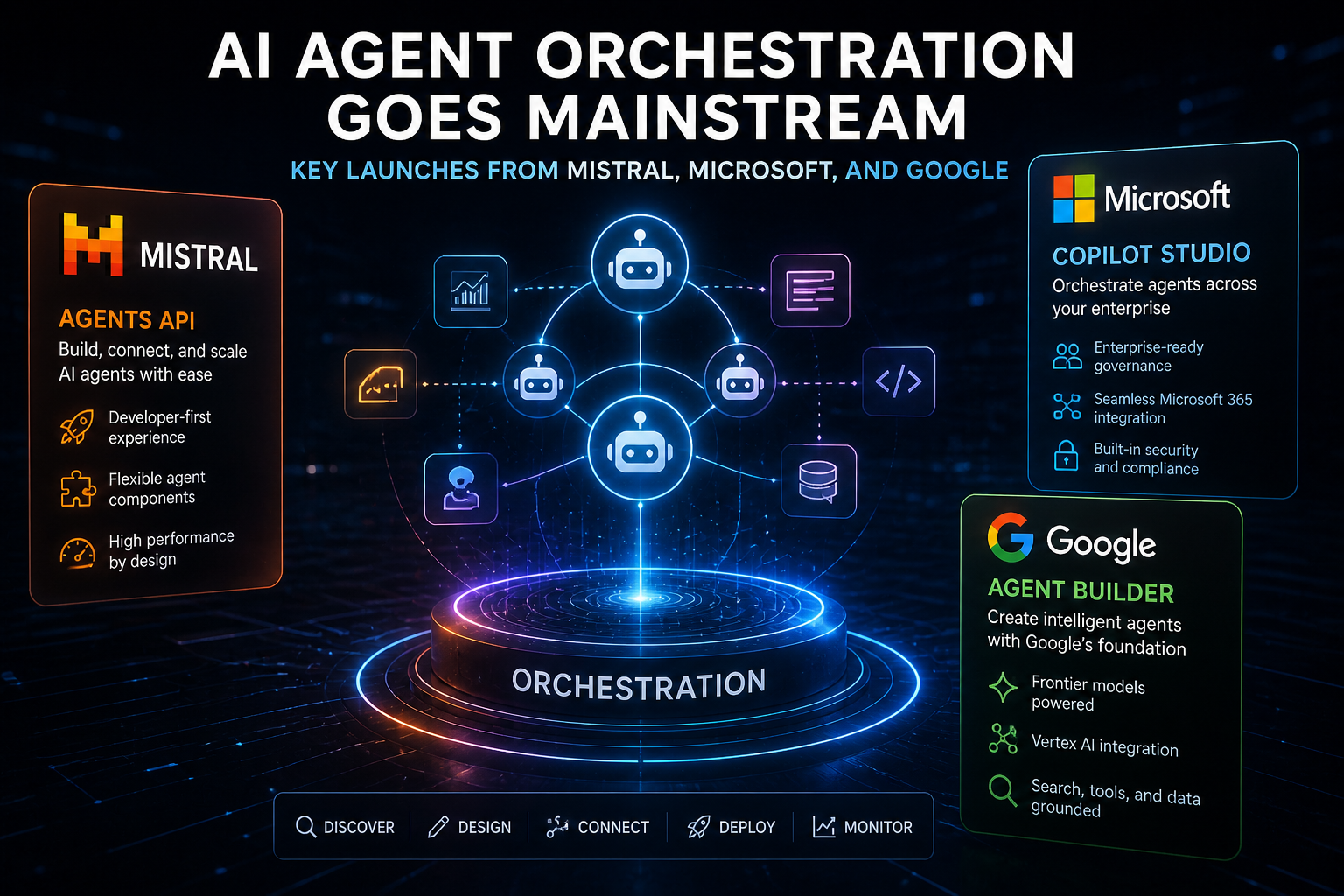
The landscape of AI agents is evolving rapidly, with major players launching orchestration platforms that promise to make building and managing agentic systems easier for enterprises. Today, let’s dive into recent announcements from Mistral, Microsoft, and Google that could change how teams deploy AI at scale.
What happened
Mistral AI introduced "Workflows," an orchestration layer for enterprise AI, built on Temporal’s engine, emphasizing reliability and observability. Microsoft announced the General Availability of its Agent Framework (MAF), set to replace Prompt Flow. Google Cloud made managed Model Context Protocol (MCP) servers generally available, providing secure integration for AI agents.
These launches highlight a shift towards standardized, enterprise-grade tools for agent orchestration.
Why it matters
For businesses, AI agents represent the next frontier in automation, but managing them has been complex. These platforms address key pain points like reliability, security, and scalability, potentially reducing development time and operational risks in enterprise AI deployments.
Who should care
CTO, AI architects, engineering leaders, and operations teams looking to integrate agentic AI into production workflows.
What most people are missing
While these tools simplify orchestration, the real value lies in their integration with existing ecosystems. For instance, Google’s MCP servers unify agent interactions across Google services, but enterprises must evaluate vendor lock-in versus open standards.
What to do next
- Assess your current AI workflows for orchestration gaps.
- Pilot one of these platforms in a non-critical use case.
- Evaluate based on integration ease, cost, and compliance features.
Bottom line
These launches signal that AI agent orchestration is ready for prime time. Choose platforms that align with your stack to accelerate delivery without compromising control.